


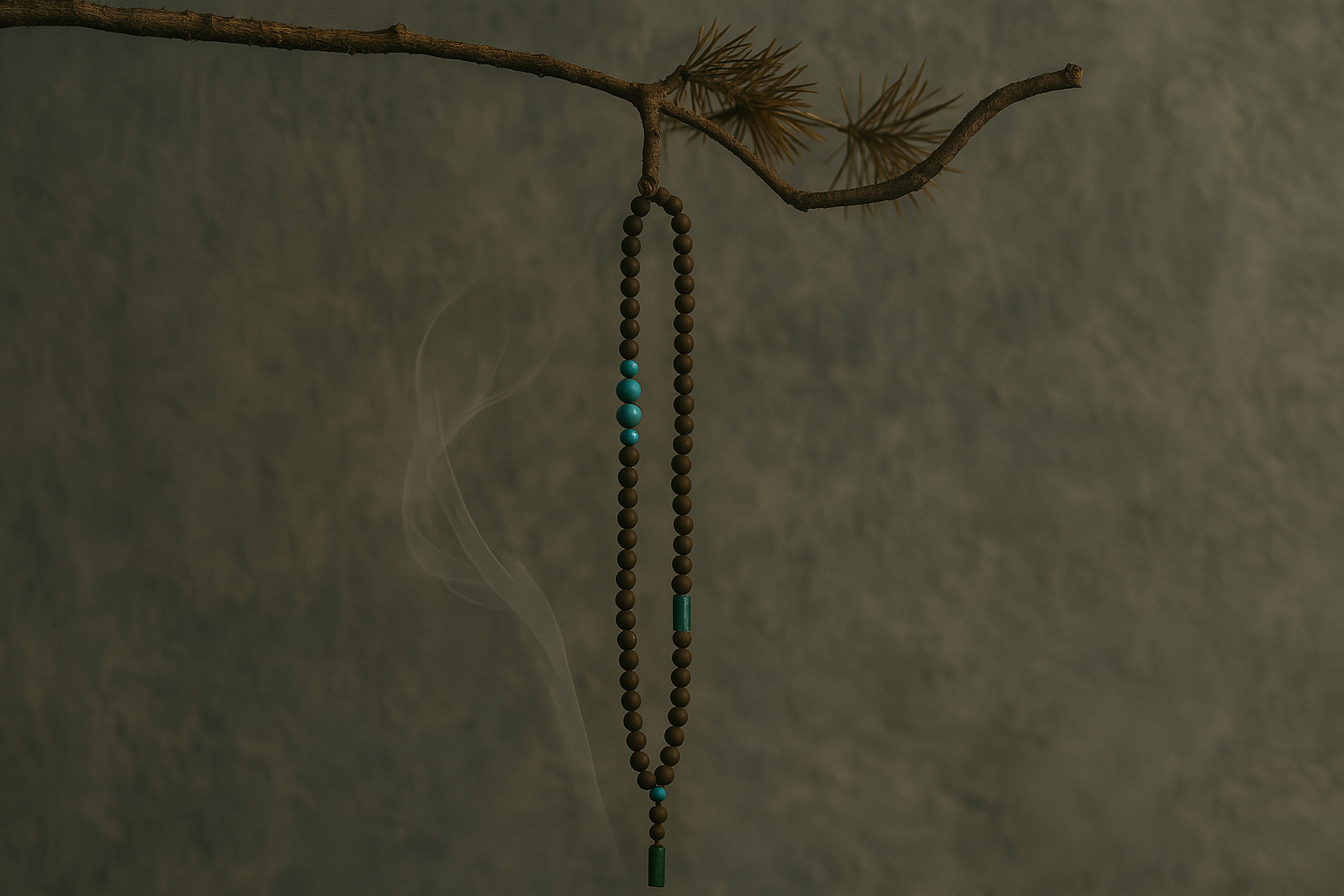
Cold-Condensed Incense Beads and the Ancient Art of Calm
In a world moving faster every day, handmade bead bracelets offer something rare:
a moment of stillness you can wear.
This idea of wearable calm is not a modern invention born from stress or burnout.
Its roots reach back more than a thousand years, to a time when human civilization—already complex and demanding—was deeply concerned with one question:
How do we maintain inner order within an intense world?
Cold-condensed incense beads are not ordinary accessories.
They belong to a rare category of handmade bead bracelets, created not for decoration alone, but as objects of intention—artisan bead bracelets shaped by traditional incense culture and modern craftsmanship.
What Are Cold-Condensed Incense Beads?
Cold-condensed incense beads are not ordinary bead bracelets.
They are a continuation of traditional incense culture, transformed into a form that can be worn on the body.
Historically, incense existed primarily in fixed spaces—burned in studies, temples, or ritual settings. Yet the need for calm was never limited to those moments alone.
Over time, incense culture evolved.
By the Song Dynasty, over 1,000 years ago, Chinese incense practice had already expanded beyond burning rituals into portable and wearable forms—carried close to the body as part of daily life. Incense was no longer confined to space; it moved with the individual.
Cold-condensed incense beads follow this same logic:
bringing scent from the environment onto the body, allowing calm to accompany everyday movement.
They are not a modern novelty, but a modern continuation.
Historical Incense Formulas and Personal Rituals in Ancient China
Long before incense beads took wearable form, fragrance in ancient China was already deeply personal. Beyond philosophical discussions of calm and refinement, specific incense formulas were created, remembered, and associated with individual figures—designed not only for spaces, but for the body itself.
Jiangzhen Incense: The Principal Note of Imperial Fragrance
Among the most valued aromatic materials recorded in classical incense texts is Jiangzhen Incense (降真香). Historically regarded as a rare and refined fragrant wood, Jiangzhen was often used as the principal note—the “Jun” element—in elite incense formulations.
Its deep, steady aroma anchored blends crafted for imperial and scholarly use, particularly within inner courts and private chambers. Rather than producing an immediate or overpowering effect, Jiangzhen incense was prized for its sense of continuity—allowing fragrance to remain close, subtle, and enduring.
This role of Jiangzhen incense, as a stabilizing aromatic presence carried through time, later became foundational to the philosophy of wearable incense traditions.
Xī Jī Incense and Zhao Feiyan: Fragrance Close to the Body
Even earlier, during the Han Dynasty—over two thousand years ago—incense culture had already entered the realm of personal adornment. Later records and interpretations describe a formula often referred to as Xī Jī Incense (息肌香), associated with Zhao Feiyan, one of the most well-known figures of the imperial court.
Unlike ceremonial incense burned in large spaces, Xī Jī Incense was understood as a close-worn fragrance—subtle, refined, and intended to remain near the body. Its aromatic structure emphasized gentleness and balance rather than projection, allowing scent to accompany movement, breath, and daily presence.
This approach reflects an early understanding of fragrance as an intimate companion rather than a display—an idea that resonates strongly with modern wearable incense beads.
From Historical Formulas to Wearable Calm
These historical incense formulas were not preserved as distant curiosities. They represent lived practices—methods by which fragrance moved from ritual spaces into daily life, from the room into the body.
Cold-condensed incense beads inherit this same intention, becoming modern wearable incense beads that translate ancient aromatic wisdom into a form that can be worn, carried, and experienced continuously within modern life.
The Foundation: Aromatic Materials Rooted in Chinese Herbal Wisdom
The calming presence of incense beads begins not with technique, but with ingredients.
In traditional Chinese culture, aromatics and medicine were never separate disciplines. Many incense materials follow the principle of “medicine and food sharing the same origin”, meaning they were understood as substances the body could gently receive.
This knowledge emerged through centuries of observation and experience.
The legend of Shennong tasting hundreds of herbs, discovering their properties through direct contact, symbolizes the earliest foundation of empirical Chinese medicine.
Classical incense and herbal texts repeatedly documented aromatic materials such as:
-
Agarwood — deep, quiet, and grounding
-
Sandalwood — steady, warm, and enduring
-
Clove — gentle clarity and warmth
-
Angelica root and Cyperus — traditionally associated with balance and harmony
These materials were not preserved by chance. They remained because generations found them suitable for influencing the body through breath, proximity, and subtle exposure.
This accumulated wisdom forms the root of Chinese incense culture.
Why Scent Brings Calm: Ancient Experience Meets Modern Science
Among all human senses, smell is unique.
Olfactory signals do not pass through language or rational filtering first. Instead, they travel directly to the brain’s limbic system—the center of emotion, memory, and perceived safety.
This explains why scent can shift our internal state before conscious thought arises.
Ancient practitioners did not know modern neuroscience, but they understood something essential:
fragrance settles the mind before the mind understands why.
Cold-condensed incense beads are formed through a low-temperature process that preserves aromatic structure. Their micro-porous composition allows fragrance to release slowly, responding subtly to body warmth.
The result is not intensity, but continuity.
And calm, by its nature, is sustained—not sudden.
Song-Dynasty Aesthetics and the Philosophy of Stillness
In Chinese thought, stillness does not mean withdrawal from life.
It means cultivating inner order within complexity.
Over a thousand years ago, scholars of the Song Dynasty developed a refined lifestyle philosophy. Among the practices known as the Four Elegances, incense appreciation was placed first.
Incense was not for display.
It was a private act—used before reading, writing, or contemplation—to align the inner state.
This practice reflected a deeper belief, expressed in classical philosophy:
“Stillness cultivates character. Stillness gives rise to clarity.”
Stillness was not passive. It was an active discipline—especially valued in periods of cultural and intellectual intensity.
From the Song Study to Modern Meditation and Yoga
This pursuit of stillness never disappeared.
It simply changed form.
Today, people turn to:
-
meditation
-
yoga
-
breathwork
-
mindfulness practices
Different cultures, different methods—yet the same intention:
to regain inner stability within fast-moving lives.
Where Song-dynasty scholars used incense to guide breath and focus, modern practitioners use conscious breathing and embodied awareness.
Cold-condensed incense beads belong to this same continuum.
Wearable Stillness: From Ritual to Daily Life
Not everyone can pause to light incense.
But the need for calm remains.
By condensing incense into beads, fragrance moves from space to body, and ritual enters daily life. This is not a simplification of tradition, but an adaptation aligned with modern rhythms.
Incense beads do not ask you to stop living.
They accompany movement, work, and thought—quietly reminding the body to slow and return.
Just as scholars once did:
not by escaping the world, but by remaining centered within it.
Heritage Craftsmanship and Contemporary Renewal
At Herimyst, cold-condensed incense beads are not replicas of the past.
They are built upon classical incense and herbal texts, guided by the traditional formulation philosophy of Jun–Chen–Zuo–Shi—a system of balance, support, refinement, and harmony.
At the same time, our research team studies modern sensory science and trains within contemporary fragrance institutions, including French perfumery education systems.
Our goal is not to modernize tradition, but to allow ancient wisdom to remain effective and meaningful today.
A Moment of Stillness, Worn Daily
Cold-condensed incense bead bracelets are not decoration.
They are companions.
From a quiet incense burner in a Song-dynasty study,
to modern meditation mats and yoga studios,
to a bracelet worn in everyday life—
Forms change.
The human need for stillness does not.
In a world that accelerates without pause,
this quiet moment becomes not a luxury, but a necessity.
And sometimes,
it is something you can wear.